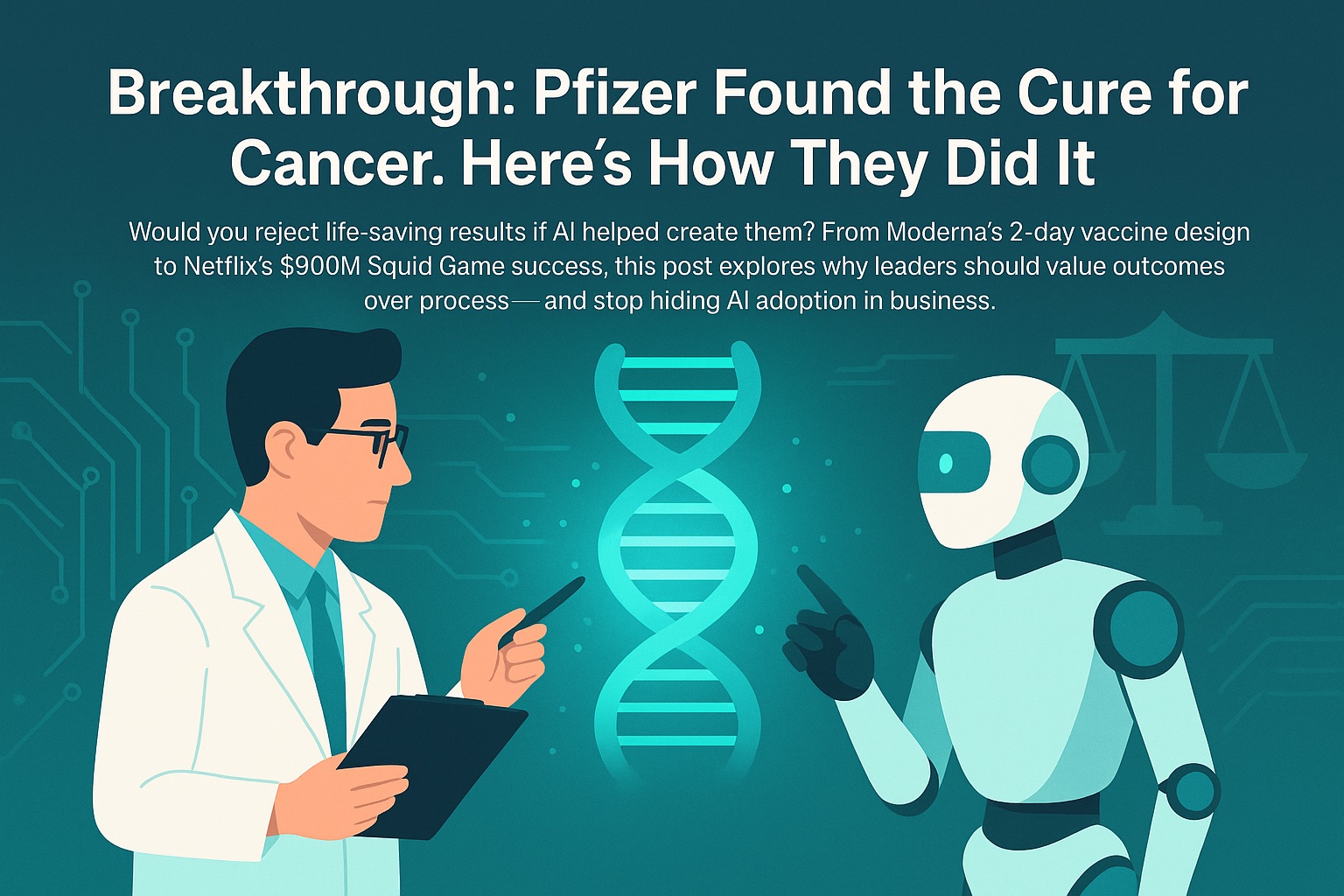
Breakthrough: Pfizer Found the Cure for Cancer. Here's How They Did It.
The first question people asked wasn’t “Does it work?”
It was “Did they use AI?”
Stop.
Read that again.
We found a cure for cancer, and people care more about the process than the outcome.
The Real Question
Does value delivered to you become less valuable if AI was involved?
If your answer is yes, would you refuse cancer treatment because AI helped find it?
Would you reject a life-saving diagnosis because machine learning spotted what humans missed?
Would you tell your child “sorry, this cure doesn’t count - a computer helped”?
It Already Happened
Here’s what most people don’t know: Moderna designed their COVID vaccine in 2 days. Not months. Days.
January 11, 2020: China released the virus genome. January 13, 2020: Moderna had their vaccine sequence ready.
They used AI and computational tools to accelerate what traditionally took months or years. Pfizer-BioNTech followed similar approaches.
The vaccines that saved millions? Technology and AI helped create them in record time.
But vaccines spark debate. Let’s look at a real, less controversial example that already happened.
The $900 Million Nobody Questions
Squid Game.
A Korean show. No traditional marketing budget. Nobody knew it existed.
Netflix’s AI-powered recommendation system put it in front of the right viewers. Result:
- 142 million households watched in first 4 weeks
- Worth $900M to Netflix
- Became a global phenomenon
- Created careers, memes, Halloween costumes
Nobody said “this success doesn’t count because algorithms promoted it.”
The creators didn’t refuse their success because AI recommendations amplified it.
You didn’t refuse to watch because AI suggested it.
Why We’re Asking the Wrong Questions
Right now, 57% of workers hide their AI use (KPMG 2025 study, 48,340 people surveyed).
Your consultants, vendors, partners - most present AI work as their own to avoid judgment.
The evidence:
- Duke University study: AI users face “negative judgments about competence and motivation”
- Workers hide AI use to protect reputation
- Those using AI daily report 81% higher job satisfaction (Slack Workforce Index)
Meanwhile, you’re already accepting AI value everywhere:
- Every Google search: AI-ranked since 2015
- Every Uber ride: AI-matched
- Every fraud alert: AI-detected
- Every Netflix show: AI-recommended
The Enterprise Reality
Two scenarios in your business:
Vendor A: Takes 6 months. Costs twice as much. Delivers “pure human” solution that barely works.
Vendor B: Takes 3 weeks. Uses AI to analyze, optimize, deliver. Solution actually works.
Your shareholders care about one thing: which creates value?
Your customers care about one thing: does it solve their problem?
Time to Stop the Theater
The shame around AI isn’t protecting human value. It’s destroying it.
When we focus on HOW instead of WHAT:
- Innovation slows (avoiding efficient tools)
- Costs increase (protecting “human” processes)
- Competition wins (while you debate methodology)
Your ERP migration isn’t less valuable if AI configured it.
Your breakthrough isn’t less innovative if AI helped find it.
Your solution isn’t less powerful if AI amplified your thinking.
The Only Question That Matters
Moderna’s vaccine saved lives. Nobody cared that AI helped design it.
Squid Game entertained millions. Nobody cared that algorithms promoted it.
Your next solution will transform businesses. Nobody will care if AI helped build it.
They’ll care that it works.
Because while you’re judging methods, your competitors are already using AI to solve the next problem.
Those using AI aren’t replacing their brains. They’re multiplying them. Stop being ashamed of your tools. Start being proud of your value.
Related Articles
If this post resonated with you, you might also enjoy:
- I Don’t Chase AI Tools - I Build With Them - How to turn AI from hype into a system that actually works for your business
- Stop Letting Tech Block Your Expertise - Why domain experts should use AI strategically to share knowledge without wrestling with technology
Have questions or suggestions? Feel free to reach out via LinkedIn or Twitter.