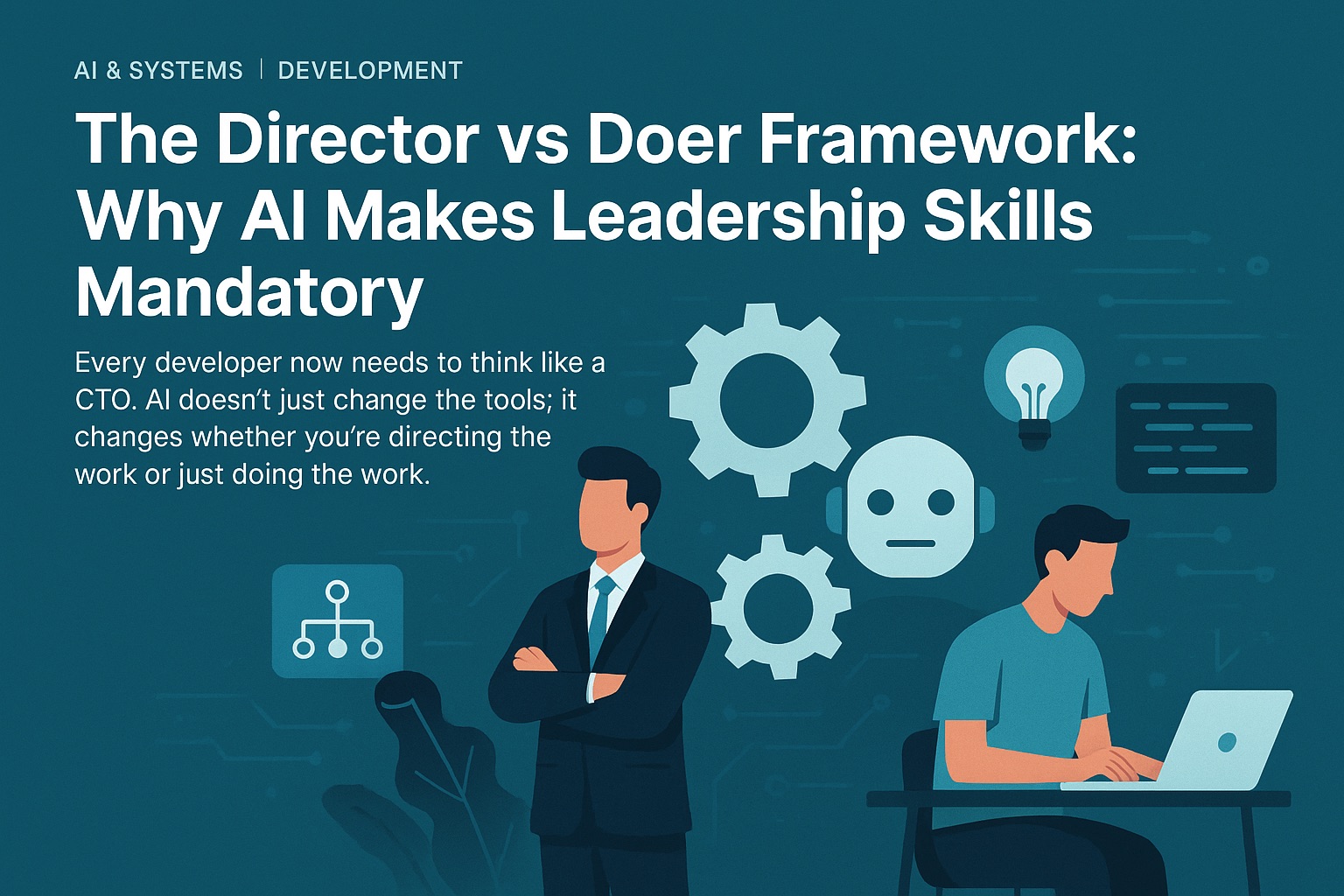
The Director vs Doer Framework: Why AI Makes Leadership Skills Mandatory
Let’s Start With Something Real
Here’s what nobody talks about: every developer now needs to think like a CTO, not a code monkey.
I’ve been watching this shift happen in real-time. Smart people getting lost in AI rabbit holes, shipping systems they don’t understand, and wondering why their productivity gains feel… hollow.
The thing is, AI doesn’t just change the tools. It fundamentally changes whether you’re directing the work or just doing the work.
And most of us? We’re still stuck in “doing” mode.
Here’s What I’ve Learned About the Framework
Dan Martell’s “Director vs Doer” concept isn’t some formal computer science theory (you won’t find it in research papers). But it nails something crucial about how we need to work with AI.
Doer mode means using AI like enhanced autocomplete. You ask it to write, code, design, execute tasks directly. You’re basically a more efficient task executor.
Director mode means treating AI like a capable team member. You provide context, set direction, define constraints, and iterate strategically. You maintain oversight of the bigger picture.
But here’s where it gets interesting (and where most people miss the point): this isn’t just about better AI collaboration. It’s about professional survival.
The Reality Check 💭
Most developers are stuck in Doer mode with AI, and it shows:
- “Write me a function that does X” then ship whatever AI gives them
- Debug problems they don’t fully understand
- No strategic thinking about outcomes
- Getting lost in iteration cycles because AI always has “one more idea”
This works until it doesn’t. Then you’re maintaining AI-generated systems you can’t properly direct.
I almost fell into this trap myself when building my blog platform. AI suggested React, Vue, custom generators. I started exploring everything. “Let’s make this more impressive” became the unconscious goal, with no clear definition of “done.”
The Director shift that actually worked? I defined the outcome upfront: “Write Markdown, publish reliably, zero maintenance.” Set constraints: preserve existing content, use existing GitHub workflow. Maintained strategic focus: this is infrastructure, not a technical showcase.
The AI wanted to show off technical possibilities. Director thinking kept me focused on business value.
What This Actually Means for You
🎯 Strategic Constraint Setting
AI can do anything, so it will try everything unless you direct it.
Directors set boundaries. Doers let AI explore every possibility.
Before every AI session:
- Define the business outcome (not just the technical task)
- Set scope boundaries (“We’re solving X, not rebuilding the entire system”)
- Write success criteria (“Done” means this specific outcome)
🔍 Outcome Ownership
What are you actually trying to achieve?
Doers optimize for impressive AI outputs. Directors optimize for business results.
This mirrors how I approach ERP implementations. Bad consultants (Doer mode) implement whatever the software can do: chasing every feature, endless customizations, no clear success criteria. Good consultants (Director mode) define business outcomes first, set implementation boundaries, push back on unnecessary complexity, and ship working systems.
📐 Context Architecture
AI needs context to be useful, but most people dump information randomly. Directors structure context systematically:
- Business requirements first
- Technical constraints second
- Success metrics third
- Then tasks
⏱️ Iteration Discipline
Here’s where the Director vs Doer distinction gets really practical…
Directors know when to stop improving and start shipping. Doers get addicted to “just one more enhancement.”
During AI work, you maintain architectural oversight and resist scope creep. After AI delivers, you review against original outcome, test at system level, and ship when criteria are met (not when AI suggests improvements).
The Business Impact (And Why This Matters)
Doer mode costs:
- Longer project timelines (endless iteration)
- Technical debt (solutions you don’t understand)
- Scope creep (chasing every AI suggestion)
- Poor fit (optimizing for AI capabilities instead of business needs)
Director mode benefits:
- Faster delivery (clear success criteria)
- Better outcomes (business-aligned solutions)
- Maintainable systems (you understand the architecture)
- Strategic leverage (AI amplifies your expertise instead of replacing it)
But there’s something deeper happening here…
Here’s What I’m Thinking
The people who master this Director vs Doer distinction will build better systems than those still stuck in task execution mode. It’s not about being “better at AI”; it’s about being better at directing complex work.
AI makes directorial thinking mandatory for everyone. The question isn’t whether you’ll use AI. It’s whether you’ll direct it or let it direct you.
And honestly? Most of the frustration I see people having with AI comes down to this: they’re trying to be better Doers when they need to become Directors.
What’s Next?
I’m curious about how this plays out in different technical domains. The framework feels solid for development work, but what about data analysis? System administration? Technical writing?
If you’re working through this Director vs Doer shift yourself, I’d love to hear what you’re discovering. Sometimes the best insights come from those messy, real-world conversations where theory meets practice.
Let’s Keep This Going
Drop me a line on LinkedIn or Twitter if you’re wrestling with similar challenges or have a different take on this whole Director vs Doer thing.
The most interesting part of this framework isn’t the concept itself; it’s how differently it plays out when you actually try to live it.